The 13 best B2B sales intelligence platforms and tools, ranked for startups and small sales teams: public pricing, seat minimums, bot-free options, and the honest limitation of each one. Apollo.io leads on contact data value with a free plan and self-serve paid tiers, Clay leads on waterfall enrichment, and Nimitai covers pre-call briefs and call plans (live coaching in early access) at $149 per seat with no seat minimum.
A field-tested system for handling price objections in B2B sales: why they really happen, a 7-step framework, 15 word-for-word scripts by scenario, DISC-specific responses, and the 5 mistakes that quietly lose winnable deals.
Gong integrates with Salesforce through a managed AppExchange package that syncs bidirectionally. Gong writes calls, emails, and activity onto your records, and reads pipeline fields back for its deal boards. The integration itself is included in every Gong plan; the platform it comes attached to is the expensive part. Here is the full technical breakdown: sync architecture, the 7-step setup, custom fields, common issues, and how the Nimitai Salesforce integration compares at $149/seat/month with no seat minimum.
MEDDIC is a B2B sales qualification framework that checks six things before you forecast a deal: Metrics, Economic Buyer, Decision Criteria, Decision Process, Identify Pain and Champion. You score each letter on buyer evidence, not rep optimism, and any letter with no evidence marks the deal as at risk. It was created at PTC in the 1990s and is still the standard for multi-stakeholder B2B deals; MEDDPICC adds Paper Process and Competition.
Everything a B2B sales leader needs to understand, implement, and modernise the Challenger Sale methodology in 2026: the 5 rep profiles from Dixon and Adamson, Teach, Tailor, Take Control, the Commercial Teaching framework, how it compares with Solution Selling, Sandler and MEDDPICC, and the AI angle most write-ups still miss.
The Sandler sales methodology in depth: the 7-step Sandler Selling System, the Pain Funnel's 8 questions, Up-Front Contracts, the Submarine model, Sandler vs MEDDPICC vs Challenger vs SPIN, the certification landscape, common mistakes, and how AI detects Pain Funnel questions on every sales call.
SPIN Selling is the most empirically grounded discovery methodology in B2B sales, built from 35,000 calls across 23 countries. Full breakdown of the four question types, the 4-stage call structure, 25 ready-to-use SPIN questions, a comparison to Challenger, Sandler and MEDDPICC, and how AI surfaces SPIN moments live.
DISC sorts buyers into four core styles: Dominant, Influential, Steady and Conscientious. Add the 12 blends (such as DI, SC or CD) and you get 16 types. No single rep profile sells best; close rate tracks how well you adapt pace, proof and close style to the buyer. Below: the full 16-type table, cues to spot each type from email and LinkedIn, and how to pitch each one.
MEDDPICC is an 8-step sales qualification framework for B2B deals. A MEDDPICC template is the scorecard that puts it to work. It captures eight qualification dimensions (Metrics, Economic Buyer, Decision Criteria, Decision Process, Paper Process, Identify Pain, Champion, Competition), each scored 0 to 3 with a supporting buyer quote. Below: a free paste-ready template, Salesforce and HubSpot field maps, and an Excel version.
12 US states are two-party (all-party) consent: California, Delaware, Florida, Illinois, Maryland, Massachusetts, Michigan, Montana, Nevada, New Hampshire, Pennsylvania, and Washington. The other 38 states plus DC are one-party. The plain-English guide to every state, federal ECPA, interstate calls, workplace rules, GDPR, penalties, and how to disclose recording legally.
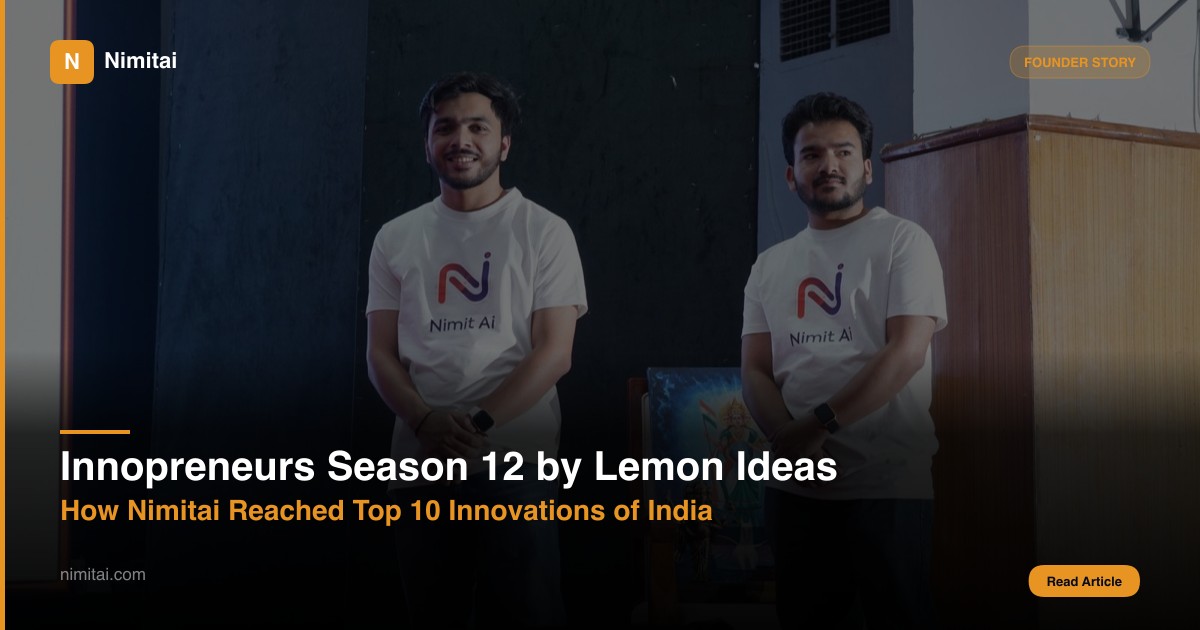
Everything about Innopreneurs by Lemon Ideas in one place: our honest review after placing 6th of 2,500 at Season 12, the full Top 10 winners list, the judges and people we met, how to apply for Season 13, what pitch day looks like, and the lessons we took home.
The expected ROI of conversation intelligence software is 4 to 12x in year one for most B2B sales teams, with measurable payback in 60 to 90 days. Formula: ROI = (incremental revenue minus annual platform cost) divided by annual platform cost, times 100%. Below: benchmarks by team size from 5 to 50 reps, what drives the return, and the Gong vs Nimitai cost math.
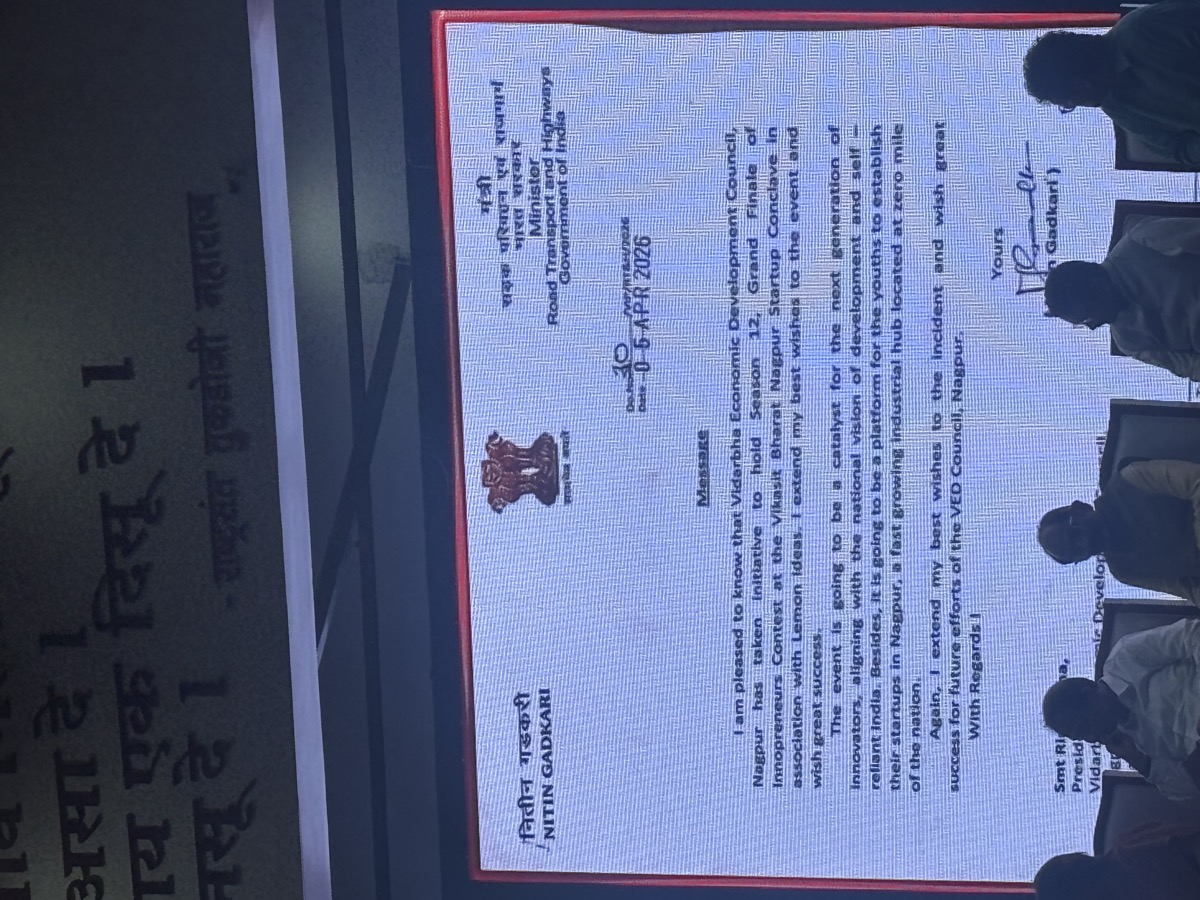
Union Minister Nitin Gadkari sent a formal letter of appreciation to the startups of Lemon Ideas Innopreneurs Season 12. We were on that list. Here is what the letter means for India's startup policy, who Deepak Menaria and Lemon Ideas are, and what happened at the Viksit Bharat Conclave Nagpur 2026.
Meeting intelligence is AI software that analyzes sales conversations to show what they mean for deal outcomes and how reps should handle the next call. A basic AI notetaker stops at summaries; meeting intelligence goes on to deal health and coaching. This guide covers how it works, the key features, who benefits and how to choose a platform in 2026.
Gong costs about $1,400 per seat per year in 2026 (most quotes land between $1,200 and $1,600), and its 15-seat minimum puts the smallest contract near $21,000 a year. Contracts are annual only, and Gong.io does not publish pricing; these figures come from customer reports and procurement leaks.
Yes, software can analyze sales call patterns: conversation intelligence tools transcribe and score every recorded call for you. To analyze sales calls, record every call, transcribe it with speaker diarization, then score it on five metrics: talk ratio (38-46% rep talk time is optimal), question count and quality, next-step clarity, objection handling, and competitor mentions. Compare closed-won against closed-lost calls on those five numbers to find the patterns that predict your wins.